did Alexandrinus come from Mt. Athos? - Matthaeus Muttis - Michaelis says 500s to 700s for date

Steven Avery

Administrator
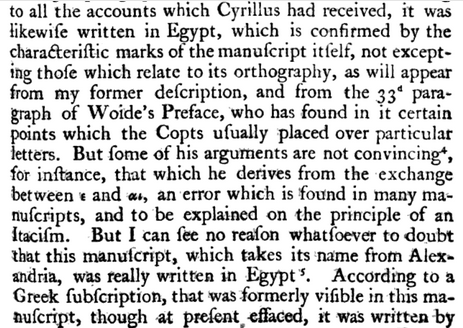
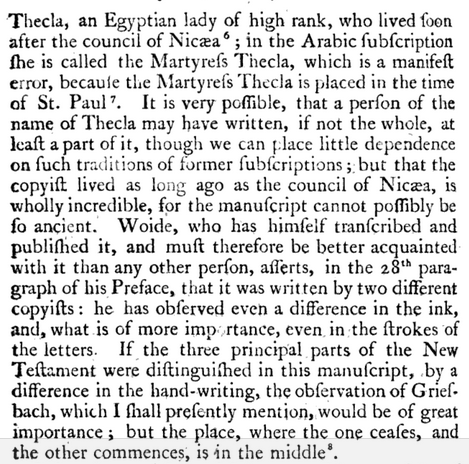
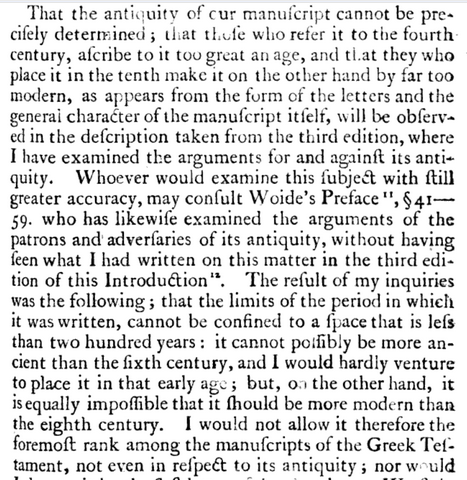
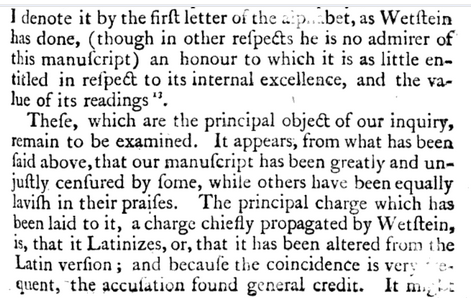
MIchaelis
https://books.google.com/books?id=Y1gHAAAAQAAJ&pg=PA187
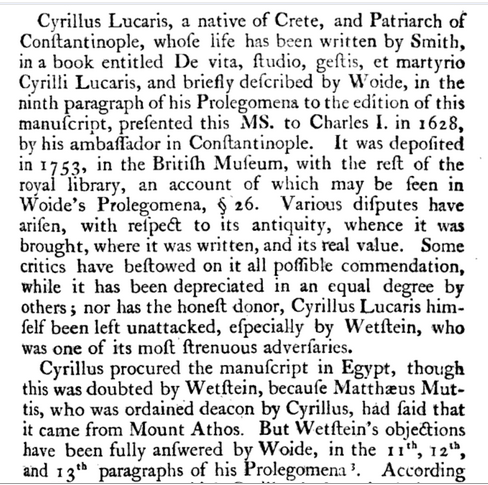
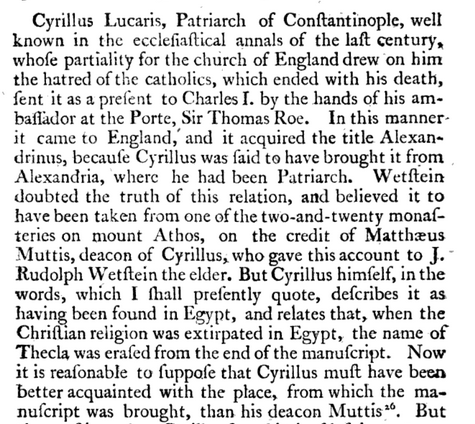
1685187342054.png

1685187389357.png

1685187427136.png

(skip a bit)
1685187515287.png

1685187553679.png


1685187188765.png

This was mentioned en passant by the Literary Churchman
 
Last edited:

Steven Avery

Administrator
A Study of the Gospels in Codex Alexandrinus: Codicology, Palaeography, and Scribal Hands (2014)
William Andrew Smith

https://books.google.com/books?id=pWHPBAAAQBAJ&pg=PA13

p. 13

However, early data regarding Lucar’s acquisition of Alexandrinus were also provided by Johan Jacob Wettstein, a Swiss chaplain serving in the Dutch army. Wettstein had worked with Richard Bentley and had delivered his collations of various New Testament texts to Bentley in 1716, hoping to encourage the scholar to publish his own edition of the Greek New Testament (which Bentley never completed).21 Undertaking the work himself, Wettstein discussed in the prolegomena of his 1751 Greek New Testament a history of Alexandrinus that he discovered in familial correspondence. Referring to two letters from his great-uncle, J. R. Wettstein, to Martin Bogdan (dated January 14 and March 11, 1664), Wettstein revealed that his great-uncle reported the witness of a Cyprian named Matthew Muttis, a deacon of the patriarch. According to Muttis, the codex was found at Mount Athos (northern Greece), in a monastery that escaped Turkish persecution through paying tribute.22 Despite assumptions to the contrary, Muttis did not explicitly claim that Cyril Lucar found the manuscript.23 In the second letter, the elder Wettstein also related that while royal librarian and patristics scholar Patrick Young was preparing an edition of Clement of Rome from Alexandrinus, a fire at the royal museum burned the book and created scorched lacunae in the text; the manuscript was only saved after being thrown from a window during the fire.24

The plausibility of the account given by Muttis will be evaluated after additional data are examined. Since the nineteenth century, debate regarding the origins of Alexandrinus and the hands it has passed through over time has centered on a few Arabic and Latin marginalia added to the text at a later date. The inscriptions/interventions that follow will be addressed in turn, noting how each has been interpreted chronologically.

21 Jebb, Bentley, 158.

22 J. J. Wettstein, // KAINHAIAQHKH (Amsterdam: Officina Dommeriana, 1751-1752), 1:10.

23 Foakes Jackson and Lake reported Muttis to have stated "that Cyril procured the codex from Mount Athos, where he was in 1612-13" (The Beginnings of Christianity, lii).

24 Wettstein, // KAINH AIA6HKH, 1:10.

25 Translation: ‘A gift given to the Patriarchal chamber in the year 814 of the martyrs."

https://books.google.com/books?id=pWHPBAAAQBAJ&pg=PA31
p. 31

1685192891555.png


1685193008488.png
 
Last edited:

Steven Avery

Administrator
Kenyon
https://archive.org/details/codexalexandrin02unknuoft/page/n7/mode/2up?view=theater&q=Muttis


" Prof. Burkitt, in a review of the New Testament volume (Journal of Theological Studies, xi. 603, 1910), has some interesting remarks, favouring the tradition recorded by Wetstein (see N. T., Introduction, p. 7, note 3) to the effect that the manuscript was found at Mt. Athos. In his opinion, the Arabic note by ‘* Athanasius the humble” may be contemporary with Cyril, and the work of one of his staff; the MS. may never have been in Egypt at all until Cyril brought it there, but may be of Constantinopolitan origin, which would account for the Constantinopolitan character of its text in the Gospels. If an Arabic scholar and palaeographer states that it is not possible to be certain whether a note was written in the fourteenth or the seventeenth century, it is not for those who have no knowledge of Oriental palaeography to dispute the statement ; but it does seem absolutely impossible to believe that Cyril had himself brought the MS. from Athos to Alexandria. If Cyril had himself found it at Athos, and presented it to the patriarchate at Alexandria with an anathema on its removal, it is not very likely that he would have transferred it to Constantinople, and still less likely that he would have impressed its Egyptian origin on Sir Thomas Roe (as he evidently did), and suppressed its Athoan derivation and his own merit in discovering it. But even if these difficulties are ignored, it is plainly incredible that he should with his own hand have stated its Egyptian origin, as he does in the autograph note prefixed to the manuscript, and should have attributed the mutilation of the end of the MS. to the ill-treatment which the Christians and their books suffered after the Mahomedan conquest of Egypt. This note makes it certain that Cyril himself believed in the Egyptian origin of the MS.; and in face of this evidence, the statement of his deacon, Matthaeus Muttis, falls to the ground. One is tempted to say that Prof. Burkitt's suggestion has only the attractiveness of the improbable.
 
Last edited:
Top