
Volkmar rips Tischendorf and Barnabas in 1864

Steven Avery

Administrator
Mentioned by Donaldson
1706915364654.png

1864
https://books.google.com/books?id=b...=2ahUKEwii6_vR442EAxUdl4kEHbWQDMwQ6AF6BAgHEAI

Zeitschrift für wissenschaftliche Theologie, Volume 8
https://books.google.com/books?id=k_hOAAAAYAAJ&pg=PA445

https://books.google.com/books?id=uMpNAQAAMAAJ&pg=RA1-PA445

https://books.google.com/books?id=w76P3SXbSLEC&pg=PA445

 
Last edited:

Steven Avery

Administrator
Kevin McGrane
Sir James Donaldson ... who dealing chronologically with all the editions of Barnabas taken from the text discovered in Codex Sinaiticus lists Tischendorf’s of 1862 and 1863, Dressel’s of 1863, Volkmar’s of 1864, Hilgenfeld’s of 1866, and Müller’s of 1869, and then adds Simonides also printed an edition of the entire text, as found in the Sinaitic, with notes; on the title-page of which the date is 1843, and the place of publication Smyrna.207
 

Steven Avery

Administrator
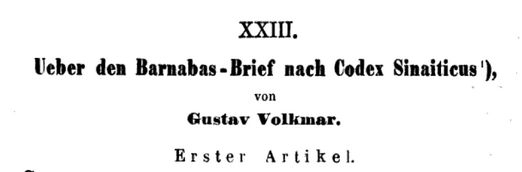
XXIII.
Ueber den Barnabas - Brief nach Codex Sinaiticus'),
von
Gustav Volkmar.
Erster Artikel.
So oft Tischendorf in die Posaune gestossen hat, dass wir erst jetzt, durch die Sinaibibel den Barnabas urkundlich besässen, so wenig hat er dazu gethan, dies zu bewahrheiten. Auch als er für die Dressel'sche Ausgabe der Apostolischen Väter (Leipzig, bei Hinrichs 1859 ed. II, 1863) den Inhalt des Cod. Sin. verwerthen sollte, hat er nur zum drittenmal die Handschrift ab- oder nachdrucken lassen, so weit das Griechische bis dahin fehlte, ausserdem eine blosse Variantensammlung beigegeben. Was können aber alle Lobpreisungen helfen, wenn der Cod. trotz seines hohen Alters gerade bei diesem Theile dergestalt so unlesbar, fehlervoll, lückenhaft, kurz ungenügend ist, als jede nähere Betrachtung lehrt? Es liegt selbst mehrfach reiner Nonsens vor (wie 1, 6. IV, 8. 12), den Tischendorf nicht durch die blosse Anmerkung hebt,, nihil notatum." Aber auch das fortgesetzte
99
1) Mit besonderer Rücksicht auf „Weizsäcker, Zur Kritik des Barnabas - Briefes. Programm der Tübinger Universität 1863" und auf das Oster-Programm der Züricher Universität Monumentum vetustatis Christianae ineditum, ex recensione G. V. (cum indice lectionum aestivarum). Turici 1864." [Fast gleichzeitig mit dieser Abhandlung erscheint als fascic. II. meines Novum Testamentum extra canonem receptum die Bearbeitung des Barnabas. Anm. d. Herausg.]


Aussprache - Verderbniss (a = &, Ɛ = αl; El = 1, 1 = &l; 1=1= ει; υ = o) ist so sinnentstellend oder Verständniss erschwerend, dass selbst Tischendorf diese orthographischen Barbarismen mehrfach nicht mehr verstanden hat (III, 10. IV, 8). Ohnehin ist Cod. Sin. für Ep. Barnabas der älteste, aber nicht der einzige Zeuge; und mag Lat. Int. noch so lückenhaft, epexegisirend, selbst katholisirend sein, der ihm zu Grunde liegende Graecus (L zu bezeichnen) wird durch Clemens Al.'s wörtliche Citate, wie durch den Zusammenhang so oft unterstützt, dass ohne dessen vollständige Durchdringung von einem zuverlässigen Barnabas - Text nicht die Rede sein kann, wozu der in den fünf Abschriften vorliegende zweite griechische Zeuge (als erst bekannter A zu nennen) auf das erheblichste tritt. Kurz die editio oder repetitio textus Sinaitici fere barbara von Tischendorf giebt keineswegs das wichtige Denkmal des Urchristenthums ganz urkundlich, sondern nur den Anstoss, das Ursprüngliche endlich annähernd zu gewinnen.
Dabei hilft es nicht viel, an einzelnen Stellen sich zu versuchen, wie Weizsäcker unternahm, so lange nicht die Weise des Codex in seiner Totalität erfragt ist 1). Bedarf es also einer neuen Ausgabe der wichtigen Urkunde, so habe ich einen Anfang davon mit dem Versuche gemacht, wenigstens den bis dahin noch nicht bekannt gewesenen griechischen Text c. 1-5 einheitlich zu ediren, nach denselben Principien und derselben Methode, die ich bei der editio princeps des Esra-Propheten befolgte. Indem ich den Versuch Allen zu um so angelegentlicherer Prüfung empfehle, je unmittelbarer dieser erste Benutzer des Esra - Propheten in die urchristliche Entwicklung, so in die NTliche Kritik eingreift, glaube ich diese Mahnung nicht besser unterstützen zu können, als wenn ich sofort selbst einige devτeque
1) So war Weizsäcker im Stande, die Punctation des Cod. zu IV, 4, die nach aller sonstigen Analogie einen Schreibfehler notirt, als Interpunction anzusehen.


yoovτídes zufüge, zur nähern Bestimmung, wie zur Ergänzung.
Cap. IV ined. (nach meiner Abtheilung v. 8) lautet der Cod. so και μη ομοιουσθαι τισιν επισωρευοντες ταις αμαρ τιαις υμων λεγοντας.“ Tischendorf glaubte hier grösste Verderbniss zu finden, als sei εnσwqεvo vтε ebenso verkehrt als λέγοντας. Ich glaube gezeigt zu haben, dass Tischendorf nur, wie öfters, zu wenig Philolog ist, wenn auch noch so guter Diplomatiker. Der Satz ist ganz richtig, wenn man nur oμolovσda so liest, wie der Cod. sonst hundert und tausendfach an die Hand giebt oμolovo 98! Es ist dann nicht ein Wort zu ändern. Nun ist aber in der von mir angeordneten Abschrift des Cod. ein αμαρτίαις υμιν (statt du. uwv) eingedrungen und trotz sorgfältigster Vergleichung stehen geblieben: daher meine Conjectur,, Taïs ταῖς ἁμαρτίαις [ὑμῶν] ὑμῖν λέγοντας.“ So habe ich also conjicirt, was der Cod. selbst enthält, und man streiche nur die Zeichen der Conjectur nebst dem vuiv, das ja danach ganz überflüssig ist. Es erhärtet sich damit meine Lesung des Tischendorf irreführenden oμolovoda nebst dem dazu p. 13 Ausgeführten. - Die corrupte Stelle des Cod., die sich IV, 8 anschliesst λεγοντας οτι διαθηκη ημων μεν αλλ εκεινοι ούτως εις τελος απωλεσαν αυτην, heilte ich nach Massgabe des Zusammenhanges, von L geleitet durch diese Ergänzung und Schreibung ... λέγοντας ὅτι διαθήκη [καὶ ἐκείνων καὶ ἡμῶν] Ἡμῶν μὲν, ἀλλ ̓ ἐκεῖνοι Dabei wird es auch wohl wesentlich bleiben: nur kann man fragen, ob die nothwendige Einschaltung ἐκείνων καὶ ἡμῶν auch ein vorangehendes xaí bedürfe. Ich glaube nicht, und möchte es umsomehr beanstanden, als Int. Lat. bietet,,testamentum illorum et nostrum est." Mag der auch mit Zusetzung des est latinisirt haben, ein xaí scheint er vor exɛívwv doch nicht vorgefunden zu haben. Wird auch am Sinne Nichts geändert, so darf doch auch nicht das Geringste übergangen werden, wo es sich um Urkunden handelt.
[ocr errors]

...
[xai
Die erste, völlig corrupte Stelle des Sinaiticus Barn.

I, 61), die Tischendorf einfach in Kauf genommen, Weiz- säcker evident vergeblich tentirt hat (vgl. m. p. 6), hat ihre Heilung durch die Unterstellung, ευφροσυνη sei aus εὐφρο σύνης hervorgegangen, εν δικαιοσυνης dagegen aus ἐν δι xaloovn. Damit hat der räthselhafte Passus doch überhaupt einen Sinn, ohne dass ich einer andern, vielleicht künstlichern Conjectur den Weg verschliessen möchte. Nur soll man die einfache Vermuthung, εvyooσvvn sei aus - νης, Sixaiooving aus vn hervorgegangen, nicht so ansehn, als δικαιοσυνης sei eine blosse Genitiv-Verwechslung eingetreten. Vielmehr konnte das regelrecht geschriebene dixaloovvHI zu ..HC verlesen, und suppoσúvηs nach dem vorangehenden άɣáлŋ zu εὐφροσύνη adäquirt werden.
[ocr errors]

--

Zu dem II, 10 fraglich gewordenen sniλvtoi, das als лýλvτoι zu lesen kaum Conjectur zu nennen ist, vgl. ausser dein von mir schon Nachgewiesenen auch Sin. Apostg. 3, 12, wo gleichfalls durch & geschrieben ist, da Beides lautete. Die IV, 13 vorkommende Seltsamkeit ɛav un vvv ev τω ανόμω καιρω και τους μελλουσιν σκανδαλοις αντιστωμεν glaube ich durch präcisere Vergleichung des Lat.,, si non modo [i. e. nisi nunc] iniquum [lies Iniquum] et futuras tentationes habeamus [lies caveamus aus haveamus]" durch diese Transposition aufgelöst zu haben: ἐὰν μὴ ἐν τῷ νῦν καιρῷ τῷ ̓Ανόμῳ καὶ τοῖς μέλλουσιν σκανδάλοις ἀντιστῶMev. Dem Beweis für die Nothwendigkeit dieser Umstellung (m. p. 14 f.) füge ich die Erinnerung hinzu, dass Cod. Sin., durch das ganze N. T. hin an Transpositionen zweifelloser Art überreich, gleich unmittelbar vorher IV, 12 eine solche bietet:,,dio meina var nosɛxoμεv" lies, wie zweifellos, τὸ περίψημα ὑμῶν [ν]. Διὸ προςέχωμεν . Dazu kommt im speciellen Falle das Vorausgehende wie Nachfolgende. Vorangeht,, Nicht nützt euch o nas zgóvos eures πᾶς χρόνος
μεν.
66
1) Τρια ουν δογματα εστιν κυριου ζωη πιστις ελπις αρχη και τελος ημων και δικεοσυνη κρισεως αρχη και τελος αγαπη ευφροσυνη και αγαλλιάσεως εργων εν δικαιοσυνης μαρτυρία.

Christseins," dem entspricht,,, es kommt also darauf an, auch v to vuv xaιow, dem Bösenfeind zu widerstehen," eben so völlig als wohl nur. Der nachfolgende ὁ Μέλας hat ferner seine rechte Vorbereitung nur durch den vorangehenden ὁ ̓Ανομος. Endlich sagte der Verf. schon IV, 2 ἐν τῷ νῦν καιρῷ.
In allem Uebrigen glaube ich die an Cod. Sin. vorgenommenen Berichtigungen von selbst einleuchtend zu sehen. Daneben möchte ich aber auch auf die interpungendo gegebene Interpretation an so manchen schwierigen Stellen aufmerksam machen. In Betreff des besonders schwierigen Zusammenhangs im Anfang des schon griechisch (durch A) vorhandenen Textes IV, 6-9 wird über das zu v. 6 wie zu v. 9 (p. 17. 19) Bemerkte wohl wenig Zweifel sein können. Aber die Revision giebt anheim, nunmehr v. 7-8 geradezu als eine Parenthese zu fassen zu dem v. 6 Vorangehenden „iva αὐτὸς ἑαυτῷ τὸν λαὸν τὸν καινὸν ἑτοιμά η. Das sei nicht Israel, sondern die Sünderwelt der Heiden. Es schliesst sich dann v. 9 völlig an v. 6, worauf doch jedenfalls zurückgegangen wird (p. 19): Also setze nicht bloss nach v. 8, wie (p. 19, 3) geschehen, sondern auch vor v. 7 [vor Пégas yε] (p. 17, 10) das Zeichen der Parenthese. Interpunction ist ja Interpretation.
II. Nach diesen textualen Erinnerungen zu dem Graece ineditum des Briefes geziemt sich ein Blick auf das Ganze desselben, wie es im neuen Cod. vorliegt.
Weizsäcker erregt den Schein, als wenn wir durch Sin. zu einer völlig neuen Ansicht über den Brief gelangten. Ich kann das nicht finden. Der Brief hat und behält auch nach Sin. die dogmengeschichtliche Bedeutung, ein Vorposten der Gnosis zu sein, ihr nächst stehend, gleichsam in sie überführend, und doch noch von der eigentlichen, d. h. bewusst dualistischen Gnosis unberührt. Was die frühere Kritik über den Brief aus dem griechischen Text cap. 6-21 geschlossen hat, Schwegler, Baur, Hilgenfeld VIII. (4.) 29

(Apost. Väter 1853), m. R. J. (S. 392 f.), ist nirgends durch Sin. durchkreuzt. Denn ist auch A jünger als Sin., so ist sein Text doch gar nicht so depravirt, als man nach Weizsäcker vermuthen müsste. Ganz abgesehen davon, dass Sin. augenscheinliche Fehler enthält, wo A mit L zusammensteht, wüsste ich aus dem bei Sin. wirklich Ursprünglicheren Nichts zu nennen, was dogmatisch in's Gewicht fiel, als dass Mose bei Sin. geradeaus,, auch einer der Propheten" heisst, dass also das ganze A. T. lediglich und ausdrücklich als Prophetie oder Orakel auf J. Chr. hin gilt, wie ja factisch durch den ganzen Brief hin.
Dogmatisch wirklich Neues finden wir durch Sin. nur da, wo bisher bloss der abbreviirende, oder wie mir immer mchr einleuchtet, katholisirende Int. Lat. bekannt war. Aber in welchem Sinne? Gerade in dem, den Weizsäcker abwehren möchte. Die Gnosis soll ein fremdes Eingewächs in's Christenthum sein, Barnabas Nichts damit gemein haben. Es war schon stark, dass Weizsäcker umgehen konnte, was Hilgenfeld so klar wie wahr formulirt hat,,in dem bösen Feind, der die Juden über den geistigen Sinn des A. T. verdunkelt, den er ihnen sinnlich gestaltet, ist der Demiurg der Gnosis zwar nicht ausgesprochen, aber principiell angebahnt." Nur ein kleiner Schritt weiter ist's, dass das sinnliche A. T. von vornherein von einem niedern Geist eingegeben sei. Diess ist durch Sin. mit Nichts aufgehoben. Und was sagt das durch ihn wirklich Neue? Es bekräftigt nur das nahezu Gnostische," es bezeugt nur noch aus · drücklicher die Bewegung, die selbst von juden christlichem Standpunct aus zur Ausscheidung des alten sinnlichen Judenthums führte, im Sinne eines rein geistigen Verständnisses der,,h. Schriften" (A. T's.), als,, vom Geiste," dem Christus - Geiste eingegeben. Mit dieser Auffassung des Christus als des ewigen Gottes - Geistes selbst, die von der Gnosis so mannichfaltig weiter entwickelt ist, steht im engsten Zusammenhang das Leben im Geiste, das ewige Leben. Liess nun Int. Lat. den Verfasser (1, 6) sagen,, ,Tres sunt ergo consti
[ocr errors]


[ocr errors]

tutiones domini: vitae spes, initium et consummatio," war ein blosses Hoffen auf ewiges Leben, dieses als bloss jenseitiges ausgesprochen. Dem griechischen Text zufolge, den Int. nur katholisirend depravirt hat, hat der Verf. das gerade Entgegengesetzte im Sinne vor Allem sei,, Leben, Glauben, Hoffnung Anfang und Ende von uns," von unserm Christsein, also das,, Leben," das ewige Leben schon im Anfange unseres Christseins vorhanden. Das ist zwar principiell christlich, ein Princip im wirklich apostolischem Christenthum, aber so ausdrücklich ausgesprochen hat es erst die Gnosis und das ihr Nächststehende.
In demselben Sinne, dass der Geist (Gottes)" den Christus wie den Christen bildet, nennt Barnabas laut Sin. alle Christen,, die Söhne Gottes" (ws пoέne vioïs dɛou, sicut decet filios dei), woraus katholische Hände das alte verwirrende,, sicut dicit filius dei" gemacht haben. Gleich der Anfang ruft zu allen Christen als ,, Söhnen und Töchtern," ohne Zweifel Gottes. Noch ausdrücklicher nur hat die Gnosis ausgeführt, was der entwickeltere christliche Geist durch unsern Alexandriner I, 3 ausspricht: wir haben „, to uvτov τὸ ἔμφυτον (To Jεov)," also die Natur, das Wesen Gottes,, empfangen durch das geistige Gnadengeschenk," was der lat. Katholiker wiederum nicht ertragen konnte und daher zu dem Widersinn verkehrt hat naturalem gratiam accepistis!" Wenn endlich innerhalb des neu entdeckten Theils des Briefes V, 8 ff. für den Verf. Christus als den,, Sohn Gottes" gerade dadurch sich manifestirt, dass er nicht das Volk Israel, sondern die Sünderwelt" der Heiden zu seinem Volk, dem neuen Gottesvolk" macht, so hätte das nahezu Marcion sagen können.
[ocr errors]

[ocr errors]

[ocr errors]


Da er dennoch völlig unberührt ist von der βλάσφημος didaoxalía Marcions, ohne daran direct Theil zu nehmen oder auch irgend dagegen zu kämpfen, so ist die Entstehungszeit dieser urchristlichen Epistel schon damit so sicher auf die antikere Zeit, vor 138 gestellt, als Ep. Polycarpi, Epp. ad Timotheum und Titum, Epp. III sec. Joh., Ev. secun

dum Joannem im Hinblick auf diese imponirendste Gnosis verfasst, erst seit 140 entstanden sind. Fragt sich nun, wann näher vor Marcion der alte Alexandriner geschrieben hat, so ergiebt sich als terminus a quo ebenso bestimmt einige Zeit nach der neuen Zerstörung Jerusalems, die der Brief cap. 16 unzweifelhaft voraussetzt. Aber auch zur Näherbestimmung der Entstehungszeit innerhalb dieses ersten nachapostolischen Zeitraums von c. 75-130 u. Z. scheint mir Cod. Sin. noch Bestimmteres beizutragen, als schon der früher bekannte Text enthielt. Im Besondern scheint mir jeder Gedanke an die Zeit Vespasian's, wie durch cap. 16 so durch cap. 4 nach dem wohl zweifellosen novum des Sin. ausgeschlossen, was Weizsäcker's apologetischer Versuch, dabei zu möglichster Frühdatirung des JohannesEvangeliums stehen zu bleiben, in volles Licht setzt; und wie schon der apokalyptische Theil des Briefes cap. 4 völlig auf die Adrianische Zeit passt, so scheint nun durch das Neue, was Sin. cap. 16 bietet, näher indicirt der Anfang derselben, speciell 118 u. Z., was einer besondern Betrachtung überlassen bleiben mag.

p. 452 END OF FIRST ARTICLE
 

Steven Avery

Administrator
On the Epistle of Barnabas according to the Codex Sinaiticus, by Gustav Volkmar. First Article. As often as Tischendorf has trumpeted that only now, through the Sinai Bible, do we have a documented record of Barnabas, he has done very little to confirm this. Even when he was supposed to use the contents of the Cod. Sin. for Dressel's edition of the Apostolic Fathers (Leipzig, published by Hinrichs 1859, ed. II, 1863), he only had the manuscript copied or reprinted for the third time, insofar as the Greek was lacking up to that point, and he also included a mere collection of variants. But what good can all the praise do if, despite its great age, the cod. is, precisely in this part, so illegible, full of errors, incomplete, in short, inadequate, as any closer examination reveals? There is even pure nonsense in several places (such as 1, 6, IV, 8, 12), which Tischendorf does not correct with the mere comment, "nihil notatum." But also the continued 99 1) With special reference to "Weizsäcker, On the Critique of the Letter of Barnabas. Program of the University of Tübingen 1863" and to the Easter program of the University of Zurich, Monumentum vetustatis Christianae ineditum, ex recensione G. V. (cum indice lectionum aestivarum). Turici 1864." [Almost simultaneously with this treatise, the treatment of Barnabas appears as fascic. II. of my Novum Testamentum extra canonem receptum. Editor's note.]

Pronunciation - corruption (a = &, Ɛ = αl; El = 1, 1 = &l; 1=1= ει; υ = o) is so distorting or makes understanding difficult that even Tischendorf has not understood these orthographic barbarisms on several occasions (III, 10. IV, 8). In any case, Cod. Sin. is the oldest, but not the only witness for Ep. Barnabas; and no matter how incomplete, epexegetical, or even catholicizing Lat. Int. may be, the Graecus (to be designated L) on which it is based is so often supported by Clemens Al.'s literal quotations and by the context that without its complete penetration, one cannot speak of a reliable Barnabas text, for which the second Greek witness present in the five copies (to be named A as the first known) plays a most significant role. In short, the editio or repetitio textus Sinaitici fere barbara von Tischendorf does not in any way provide the important monument of early Christianity in its entirety, but only the impetus to finally gain an approximate grasp of the original.

It is of little use to attempt individual passages, as Weizsäcker did, as long as the nature of the Codex has not been examined in its entirety. 1) Therefore, if a new edition of this important document is needed, I have made a start by attempting to edit at least the previously unknown Greek text (chapters 1-5) in a unified manner, according to the same principles and the same method that I followed in the editio princeps of the Prophet of Ezra. While I recommend this attempt to everyone for all the more careful examination, the more directly this first user of the Prophet of Ezra intervenes in early Christian development and thus in NT criticism, I believe I can support this admonition no better than by immediately making some devúque myself. 1) Thus, Weizsäcker was able to regard the punctuation of the Codex at IV, 4, which, according to all other analogies, notes a scribal error, as punctuation.

yoovτídes add, for further determination, as well as to supplement. Cap. IV ined. (according to my section v. 8) the code is as follows: λεγοντας.” Tischendorf believed he had found the greatest corruption here, as if εnσwqεvo vtε were just as wrong as λέγοντας. I believe I have shown that Tischendorf, as is often the case, is simply not enough of a philologist, even if he is a good diplomat. The sentence is quite correct if one only reads μolovσda the way the Cod. otherwise provides us with oμolovo 98 hundreds and thousands of times! Then not a single word needs to be changed. But in the copy of the Cod. that I arranged for, an αμαρτίαις υμιν (instead of du. uwv) has crept in and, despite the most careful comparison, has remained: hence my conjecture, Taïs ταῖς ἁμαρτίαις [ὑμῶν] ὑμῖν λέγοντας." Thus, I have conjectured what the code itself contains, and one only deletes the signs of the conjecture along with the vuiv, which is completely superfluous after that. This confirms my reading of Tischendorf's misleading oμolovoda, along with what was explained on page 13. - The corrupt passage of the Code that follows IV, 8 λεγοντας οτι διαθηκη ημων μεν αλλ εκεινοι ούτως εις I healed according to the context, guided by L through this addition and spelling... καὶ ἡμῶν] Ἡμῶν μὲν, ἀλλ ̓ ἐκεῖνοι It will probably remain essential: only one can ask whether the necessary intervention ἐκείνων καὶ ἡμῶν also requires a preceding xaí. I don't think so, and I would like to object to it all the more since Int. Lat. offers "testamentum illorum et nostrum est." Even if he may have Latinized it with the addition of est, he doesn't seem to have found a xai before exɛívwv. Even if the meaning isn't changed, nothing at all can be omitted when it comes to documents. [ocr errors]

The first, completely corrupted part of the Sinaiticus Barn.

I, 61), which Tischendorf simply accepted, but which Weizsäcker evidently attempted in vain (cf. m. p. 6), has its remedy through the assumption that ευφροσυνη emerged from εὐφρο σύνης, while εν δικαιοσυνης, on the other hand, from ἐν δι xaloovn. Thus the enigmatic passage has some meaning at all, without my wishing to close the way to another, perhaps more artificial, conjecture. However, the simple assumption that εvyooσvvn originated from -νης, and Sixaiooving from vn, should not be interpreted as a mere genitive confusion. Rather, the correctly spelled dixaloovvHI could be misread as ..HC, and suppoσúvηs, after the preceding άɣáŋ, could be translated as εὐφροσύνη.

Regarding the questionable sniλvtoi in II, 10, which, when read as лýλvτoι, can hardly be called a conjecture, see, in addition to what I have already demonstrated, also Sin. Apostg. 3, 12, where it is also written with &, since both were written. The oddity occurring in IV, 13, ɛav un vvv ev τω ανόμω καιρω και τους μελλουσιν σκανδαλοις αντιστωμεν, I believe, through a more precise comparison of the Latin, si non modo [i.e. nisi nunc] iniquum [lies Iniquum] et futuras tentationes habeamus [lies caveamus from haveamus]" to have been resolved by this transposition: ἐὰν μὴ ἐν τῷ νῦν καιρῷ τῷ ̓Ανόμῳ καὶ τοῖς μέλλουσιν σκανδάλοις ἀντιστῶMev. To the proof of the necessity of this change (m. p. 14 f.) I add the reminder that Cod. Sin., throughout the entire N.T abundantly, immediately before IV, 12 offers such a thing: "dio meina var nosɛxoμεv" read, as is undoubtedly the case, τὸ περίψημα ὑμῶν [ν]. Διὸ προςέχωμεν . Go ahead, Do not take advantage of your πᾶς χρόνος μεν

66
1). και δικεοσυνη κρισεως αρχη και τελος αγαπη ευφροσυνη και αγαλλιάσεως εργων εν δικαιοσυνης μαρτυρία.

Christianity," which corresponds to, "it is therefore a question of resisting the enemy, v to vuv xaιow," just as completely as perhaps only. The following ὁ Μέλας furthermore has its proper preparation only through the preceding ὁ ̓Ανομος. Finally, the author already said in IV, 2 ἐν τῷ νῦν καιρῷ.
1,081 / 5,000


In all other respects, I believe the corrections made to Cod. Sin. are self-evident. I would also like to draw attention to the interpretation given interpungendo in several difficult passages. Regarding the particularly difficult context at the beginning of the text IV, 6-9, which is already available in Greek (through A), there can be little doubt about what has been said about v. 6 and v. 9 (pp. 17, 19). But the revision suggests that v. 7-8 should now be interpreted as a parenthesis to v. 6 The preceding "iva αὐτὸς ἑαυτῷ τὸν λαὸν τὸν καινὸν ἑτοιμά η. That is not Israel, but the sinner world of the Gentiles." Verse 9 then follows completely on from verse 6, to which it is in any case referred back (p. 19): Therefore, place the sign of parenthesis not only after verse 8, as happened (p. 19, 3), but also before verse 7 [before Pegas yε] (p. 17, 10). Punctuation is, after all, interpretation. II. After these textual reminders of the Graece ineditum of the letter, it is appropriate to look at the whole of it, as it is in the new Cod. is available.

Weizsäcker creates the impression that through Sin. we have arrived at a completely new view of the letter. I cannot find that. The letter has and retains, even after Sin., the significance in the history of dogma of being an outpost of Gnosis, standing closest to it, as it were, leading into it, and yet still untouched by the true, i.e., consciously dualistic, Gnosis. What earlier criticism of the letter has concluded from the Greek text, chapters 6-21, Schwegler, Baur, Hilgenfeld VIII. (4.) 29

(Apostolic Fathers 1853), m. R. J. (p. 392 f.), is nowhere thwarted by Sin. For even if A is younger than Sin., its text is not as depraved as one would suspect after Weizsäcker. Quite apart from the fact that Sin. contains obvious errors where A is placed together with L, I cannot think of anything from what is truly more original in Sin. that would have dogmatic significance, except that Moses in Sin. is directly called "also one of the prophets," so that the entire Old Testament is considered solely and expressly a prophecy or oracle referring to the year 2000, as is in fact the case throughout the entire letter.

We find something truly new dogmatically through Sin. only where previously only the abbreviated, or, as it increasingly seems to me, catholicizing Int. Lat. was known. But in what sense? Precisely in the sense that Weizsäcker would like to ward off. Gnosis is supposed to be a foreign growth in Christianity, and Barnabas has nothing in common with it. It was already significant that Weizsäcker was able to circumvent what Hilgenfeld formulated as clearly as it was truly true: "In the evil enemy who obscures the Jews' understanding of the spiritual meaning of the Old Testament, which he presents to them in a sensuous way, the demiurge of Gnosis is, indeed not explicitly, but in principle prefigured." It is only a small step further to say that the sensuous Old Testament was inspired from the outset by a lower spirit. This is not at all annulled by sin. And what does that which is truly new through it say? It only reinforces the almost Gnostic element; it only testifies even more explicitly to the movement which, even from a Jewish-Christian standpoint, led to the elimination of old sensuous Judaism, in the sense of a purely spiritual understanding of the "Holy Scriptures" (Old Testament), as inspired "by the spirit," the Christ-spirit. Closely connected with this conception of Christ as the eternal God—Spirit Himself, which Gnosis developed so diversely, is life in the spirit, eternal life. Int. Lat. now had the author say (1:6), "Tres sunt ergo consti" (Three sunt, therefore, const). [ocr errors]

tutiones domini: vitae spes, initium et consummatio," was a mere hope for eternal life, expressed as merely otherworldly. According to the Greek text, which Int. has only depraved in a Catholicizing manner, the author has the exact opposite in the sense that, above all, "life, faith, hope are the beginning and end of us," of our Christianity, thus that "life," eternal life, is already present at the beginning of our Christianity. This is indeed fundamentally Christian, a principle in truly apostolic Christianity, but it was only Gnosis and its closest allies that expressed it so explicitly.

In the same sense that the Spirit (of God)" forms Christ as well as the Christian, Barnabas, according to Sin., calls all Christians "the sons of God" (ws pone vioïs dɛou, sicut decet filios dei), from which Catholic hands have transformed the old, confusing "sicut dicit filius dei." The very beginning calls all Christians as "sons and daughters," without doubt, of God. Only Gnosis has more explicitly elaborated what the more developed Christian spirit expresses through our Alexandrian I, 3: we have ", to uvtov τὸ ἔμφυτον (To Jeov)," thus the nature, the essence of God, received through the spiritual gift of grace," which the Latin Catholic, in turn, could not bear and therefore perverted into the absurdity "naturalem gratiam accepistis!" If, finally, within the newly discovered part of the letter (V, 8 ff.), for the author, Christ manifests himself as the "Son of God" precisely by making not the people of Israel, but the "sinner world" of the Gentiles his people, the "new people of God," then Marcion could almost have said that.

Since he is nevertheless completely untouched by the βλάσφημος didaoxalía of Marcion, without taking any direct part in it or even fighting against it in any way, the time of origin of this early Christian epistle is already set as certainly in the more ancient time, before 138, as Ep. Polycarpi, Epp. ad Timotheum and Titum, Epp. III sec. Joh., Ev.

secundum Joannem with a view to this most impressive Gnosis, have only been written since 140. If the question now arises as to when, closer to Marcion, the old Alexandrian wrote, the terminus a quo is just as definitely some time after the new destruction of Jerusalem, which the letter in chapter 16 undoubtedly presupposes.

But even to the more precise determination of the time of origin within this first post-apostolic period from c. 75-130 AD, Cod. Sin. seems to me to contribute even more definite information than the previously known text already contained. In particular, any thought of the time of Vespasian seems to me to be excluded, both by chapter 16 and by chapter 4 after the undoubtedly novum of Sin., which fully illustrates Weizsäcker's apologetic attempt to stick to the earliest possible dating of the Gospel of John; and as the apocalyptic part of the letter in chapter 16 already shows, 4 fits entirely to the Adrian period, the new information offered in Sin. chapter 16 now seems to indicate more precisely the beginning of the same, specifically 118 AD, which may be left for separate consideration.
 
Last edited:
Top