

Steven Avery
Administrator
"Dorhout Animadversiones appeared in 1768, with great applause"
His quotes are insightful and fun.
Council of Carthage
6. The testimony of the African Bishops,
instar centenorum codicum, qui optimae; notae: sunt seculi V. (Dorhout.)
[equivalent to that of a hundred of the best MSS. of the fifth century].
(Christian Observer 1824 p.683)
Vulgate Prologue of Jerome
"Erasmus, Socinus and Sir Isaac Newton,” says Bishop Burgess, “ ascribe the Prologue to Jerome; and Dorhout contends that it is his from the style and spirit in which it is written." (and from the testimony of early writers)
https://books.google.com/books?id=tnYYAQAAIAAJ&pg=PA21
«Potuit igitur Hieronymus scribere Graecorum Codices suisse integros; negarique non potest adeo, patres Graxos locum citare.”
https://books.google.com/books?id=_tk2AAAAMAAJ&pg=PA211
Diodorus
Stylistic and internal
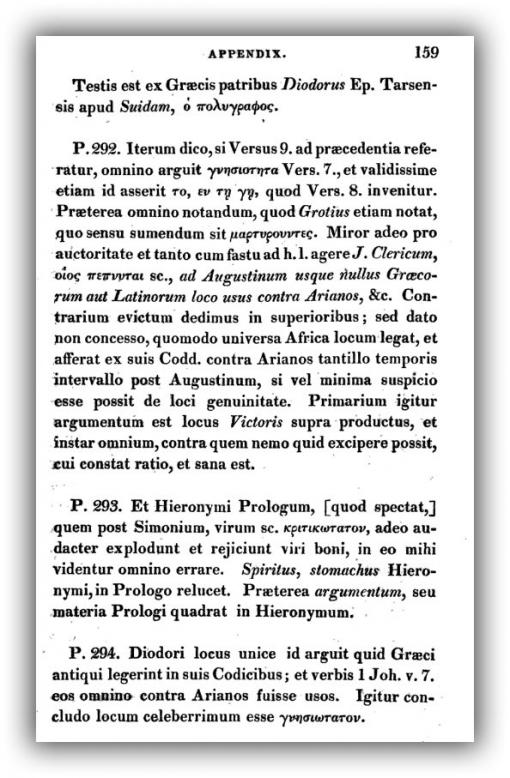
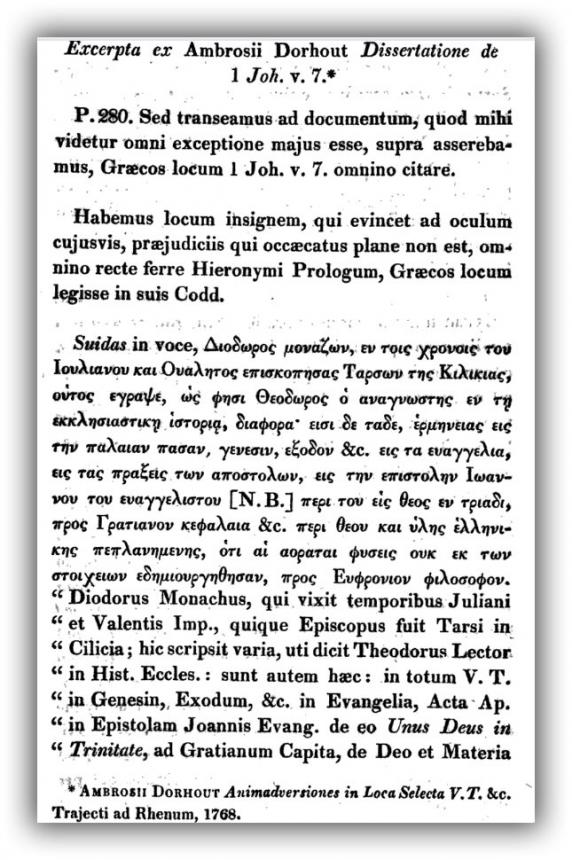
Burgess has some extracts ranging from p. 280-294
https://books.google.com/books?id=fvZhAAAAcAAJ&pg=PA157
and there is library availability in NYC.
WIP
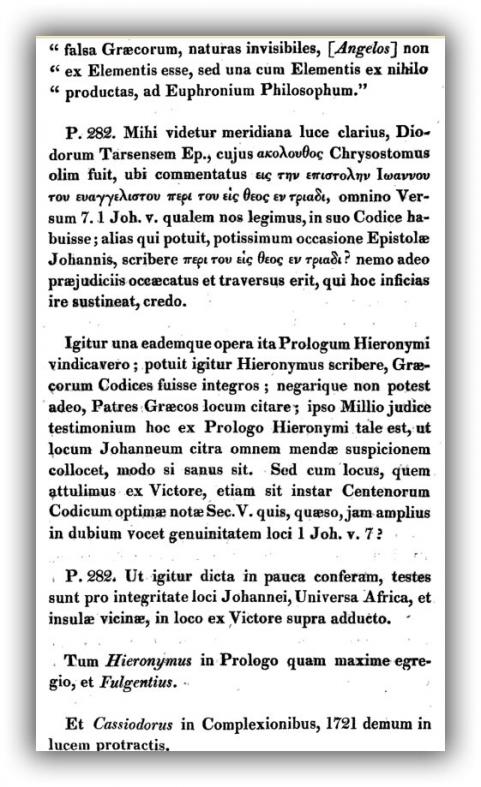
Sed cum locus, quem attulimus ex Victore, etiam sit instar Centenorum Codicum optimae; notae Sec. V. quis, quaeso, jam amplius in dubium vocet genuinitatem loci 1 Joh. v. 7 ?
His quotes are insightful and fun.
Council of Carthage
6. The testimony of the African Bishops,
instar centenorum codicum, qui optimae; notae: sunt seculi V. (Dorhout.)
[equivalent to that of a hundred of the best MSS. of the fifth century].
(Christian Observer 1824 p.683)
Vulgate Prologue of Jerome
"Erasmus, Socinus and Sir Isaac Newton,” says Bishop Burgess, “ ascribe the Prologue to Jerome; and Dorhout contends that it is his from the style and spirit in which it is written." (and from the testimony of early writers)
https://books.google.com/books?id=tnYYAQAAIAAJ&pg=PA21
«Potuit igitur Hieronymus scribere Graecorum Codices suisse integros; negarique non potest adeo, patres Graxos locum citare.”
https://books.google.com/books?id=_tk2AAAAMAAJ&pg=PA211
Diodorus
Stylistic and internal
Burgess has some extracts ranging from p. 280-294
https://books.google.com/books?id=fvZhAAAAcAAJ&pg=PA157
and there is library availability in NYC.
WIP
Sed cum locus, quem attulimus ex Victore, etiam sit instar Centenorum Codicum optimae; notae Sec. V. quis, quaeso, jam amplius in dubium vocet genuinitatem loci 1 Joh. v. 7 ?
Last edited: